
Why Australia Needs a National OCD Awareness and Treatment Strategy

Sep 13, 2026
OCD is common, disabling and frequently hidden. Earlier recognition, specialist training and clearer pathways to evidence-based care could transform lives.

Across Australia, obsessive-compulsive disorder (OCD) remains widely misunderstood. It is still trivialised as a preference for neatness, order or routine, even though clinical OCD can cause profound distress, consume hours each day and disrupt education, relationships, employment and family life.
OCD is not defined by being unusually tidy. It involves recurrent intrusive thoughts, images, urges or doubts, together with compulsions or avoidance intended to reduce distress or prevent a feared outcome. Compulsions may be visible—such as washing, checking or repeating—but they can also occur internally through reviewing memories, seeking certainty, neutralising thoughts or repeatedly testing what a thought “means”.
Some obsessions involve contamination or accidental harm. Others concern sexuality, morality, religion, identity, relationships, illness, responsibility or the fear of acting against one’s values. These experiences are often deeply shame-laden. Importantly, an intrusive thought is not evidence of desire or intent. People may conceal symptoms precisely because the thoughts feel so inconsistent with who they are.

A long delay before the right diagnosis
OCD often begins early in life, although it may not be recognised until years later. Australian clinicians and researchers have highlighted that it can take approximately nine years for an accurate diagnosis. During that interval, symptoms may become increasingly embedded in daily routines, family accommodation, avoidance and self-understanding.
Early presentations may include elaborate bedtime rituals, repeated reassurance seeking, contamination fears, school avoidance, excessive confession, “just-right” behaviours, persistent checking or distress about causing harm. These can be mistaken for general anxiety, perfectionism, developmental rigidity or difficult behaviour.
The clinical picture becomes more complicated when OCD coexists with depression, ADHD, autism, trauma-related symptoms, eating difficulties, tic disorders or other anxiety disorders. Careful assessment is needed to distinguish fear-driven obsessions and compulsions from superficially similar symptoms arising in other conditions.
Greater public understanding would help people describe their experiences earlier. Greater clinician familiarity would reduce the risk that intrusive thoughts are mistaken for intent, psychosis or a character problem.

Effective treatment exists—but access remains uneven
Cognitive behavioural therapy incorporating exposure and response prevention (ERP) is a central evidence-based psychological treatment for OCD. ERP involves carefully and collaboratively approaching feared situations, thoughts or sensations while reducing the compulsive responses that maintain the cycle.
It is not simply a matter of confronting the person with their worst fear. Good ERP is individualised, paced appropriately and based on a shared understanding of the person’s symptoms, values, developmental context and capacity to participate. Medication—particularly serotonin reuptake inhibitors—may also play an important role. More intensive or specialist approaches may be considered when illness is severe, complex or insufficiently responsive to first-line care.
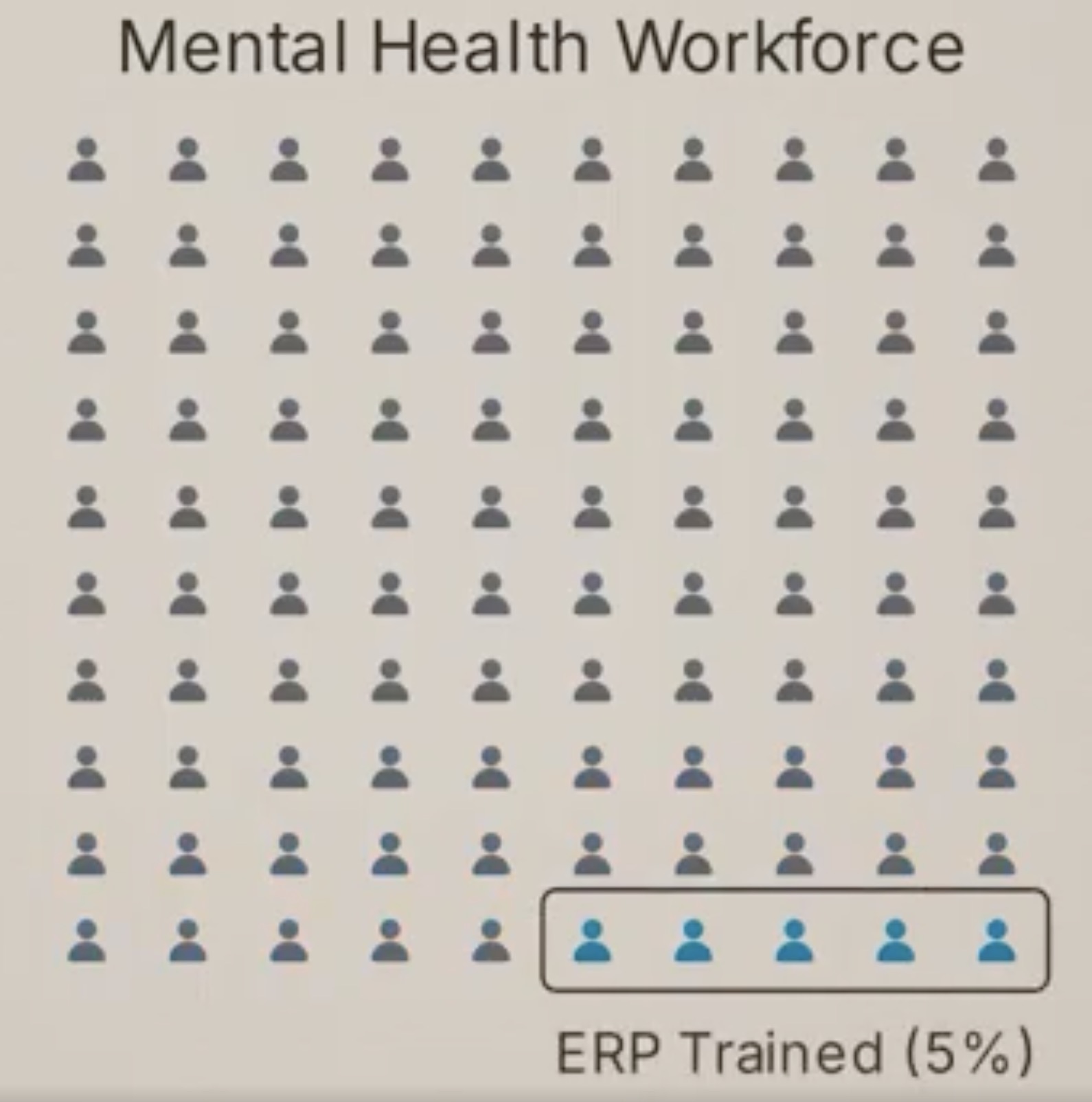
Yet finding clinicians with specific OCD assessment and ERP experience can be difficult. Generic supportive therapy may provide valuable emotional support without directly changing the reinforcement cycle that sustains OCD. A national strategy should therefore address not only awareness, but practical workforce capability, supervision and referral pathways.
Why OCD is a powerful focus for mental-health education
Understanding OCD teaches lessons that extend well beyond one diagnosis:
- thoughts can occur without being chosen;
- the content of a thought does not define the person having it;
- avoidance can bring short-term relief while strengthening long-term fear;
- repeated reassurance can become part of a compulsive cycle;
- certainty is rarely absolute; and
- effective therapy can help people change their relationship with doubt, distress and responsibility.
These concepts are relevant to families, schools, general practitioners and mental-health professionals. A well-designed OCD campaign could therefore improve broader mental-health literacy while directly reducing shame and diagnostic delay.

What a national strategy could deliver
A credible Australian OCD strategy should extend beyond a temporary awareness campaign. It could include:
- Accurate public education: replacing stereotypes with clear explanations of obsessions, compulsions, avoidance and covert rituals.
- Earlier recognition: helping parents, schools, primary-care clinicians and youth services identify possible symptoms and know where to refer.
- Workforce development: scalable training in assessment, differential diagnosis and ERP, supported by supervision and competency development.
- Stepped pathways: linking community treatment with specialist outpatient, day-program and inpatient care when complexity or severity requires it.
- Measurement-based care: using validated measures to track symptoms, disability, functioning and treatment experience.
- Research and implementation: evaluating how evidence-based treatments can be delivered safely, consistently and accessibly across different settings.
- Meaningful lived-experience participation: ensuring that people with OCD and their families help shape language, priorities, services and research.

Building practical models of connected care
At MindSkiller, our aim is to support a more connected model through structured digital assessment, outcome measurement, therapeutic resources and clinician education. This includes a specialist OCD eLearning program designed to strengthen knowledge of symptom mechanisms, related presentations, differential diagnosis and treatment pathways.
This digital work sits alongside developing clinical models within the TMS Plus ecosystem in Sydney. The ecosystem connects specialist psychiatric and psychological care with VisionTMS services at City X-Ray Martin Place and Beaches X-Ray Dee Why, Adelaide Street Interventional Psychiatric Clinic and Uspace at St Vincent’s Private Hospital Sydney.
For selected patients whose OCD is severe or difficult to treat, these programs may incorporate MRI-guided transcranial magnetic stimulation within a broader multimodal plan. Personalised AI-assisted immersive material may be developed to support symptom provocation and exposure-based work. Emerging scent technology is also being explored as a way of matching selected olfactory cues with personalised therapeutic scenes.
These innovations should be described with appropriate caution. They do not replace careful assessment, established psychological treatment or shared clinical decision-making. Not every component is appropriate for every patient, outcomes vary, and developing technologies require continuing evaluation.
Naturalistic research is intended to help evaluate feasibility, acceptability and real-world outcomes. U-INSPIRE includes young people aged 16–17 as well as young adults receiving care through Uspace. O-INSPIRE extends related data collection into associated outpatient settings. Further research applications concerning ketamine priming and AI-avatar-supported outcome measurement remain in development and should not be understood as approved or established treatments.

A moment for national leadership
Australia has an opportunity to make OCD more visible without reducing it to a slogan. A national strategy could shorten the path to diagnosis, strengthen the clinical workforce, improve access to evidence-based treatment and provide clearer pathways for people whose needs are complex.
The central message is simple: intrusive thoughts are not a person’s identity, compulsions are not merely habits, and people should not have to spend years suffering in silence before receiving informed help.
OCD deserves to be recognised as a major mental-health priority—and people living with it deserve a system equipped to recognise and treat it.

Further information
- MindSkiller: https://mindskiller.com
- TMS Plus: https://tmsplus.com.au
- General enquiries: info@tmsplus.com.au
- Clinical referrals: coordinator@tmsplus.com.au
- Video: The Malfunctioning Alarm Taming the Beast
Treatment suitability requires individual clinical assessment. Outcomes vary. Information in this article is educational and is not a substitute for personal medical advice.
Selected sources
- Australian Bureau of Statistics. National Study of Mental Health and Wellbeing, 2020–2022. https://www.abs.gov.au/statistics/health/mental-health/national-study-mental-health-and-wellbeing/latest-release
- University of New South Wales. Obsessive-compulsive disorder is more common than you think—but it can take nine years for an OCD diagnosis. https://www.unsw.edu.au/newsroom/news/2023/03/obsessive-compulsive-disorder-is-more-common-than-you-think--but
- Healthdirect Australia. Obsessive-compulsive disorder (OCD). https://www.healthdirect.gov.au/obsessive-compulsive-disorder-ocd
- National Institute for Health and Care Excellence. Obsessive-compulsive disorder and body dysmorphic disorder: treatment (CG31). https://www.nice.org.uk/guidance/cg31
- World Health Organization. Obsessive-compulsive disorder. https://iris.who.int/items/cdf5a576-38ed-4e03-8f6e-2b40562273e9